


Why Less Was More for Dire Straits
When Dire Straits entered the studio to make their first album in early 1978, almost nobody could have predicted that the quiet, economical four-piece would produce one of the most distinctive guitar records of the decade.
There was no elaborate studio concept, no huge production budget and no attempt to manufacture a fashionable rock sound. Instead, Dire Straits was built around a remarkably simple combination: Mark Knopfler’s fingerstyle electric guitar, David Knopfler’s rhythm playing, John Illsley’s bass and Pick Withers’ highly controlled drumming.
At the centre of the album was “Sultans of Swing”, a song whose journey from an obscure encounter in a pub to an international hit was almost as unlikely as the band itself.
Formed in 1977 the band, initially called the Cafe Racers, seen here at the first gig yards away from their extremely modest shared digs, times were tight often not having enough money to pay the gas bills, a friend of theirs perfectly summed up their predicament helping rename the band Dire straits.
The inspiration for “Sultans of Swing” came to Mark Knopfler in 1977, when he wandered into a small pub in Deptford, South London on a rainy night. (believed to be the White Swan on Greenwich High Road ) . Inside, a little Dixieland jazz band was playing to almost nobody. Knopfler even remembers requesting standards such as “The Creole Love Call” and “Muskrat Ramble.” At the end of the evening, the band announced themselves as the “Sultans of Swing”—a grand name that seemed hilariously out of place.
Knopfler later recalled: “Sultans, they absolutely weren’t. You know, they were rather tired little blokes in pullovers.” Amazingly the band themselves never revealed themselves following teh success of the record and no one has been able to trace them. But to be fair the
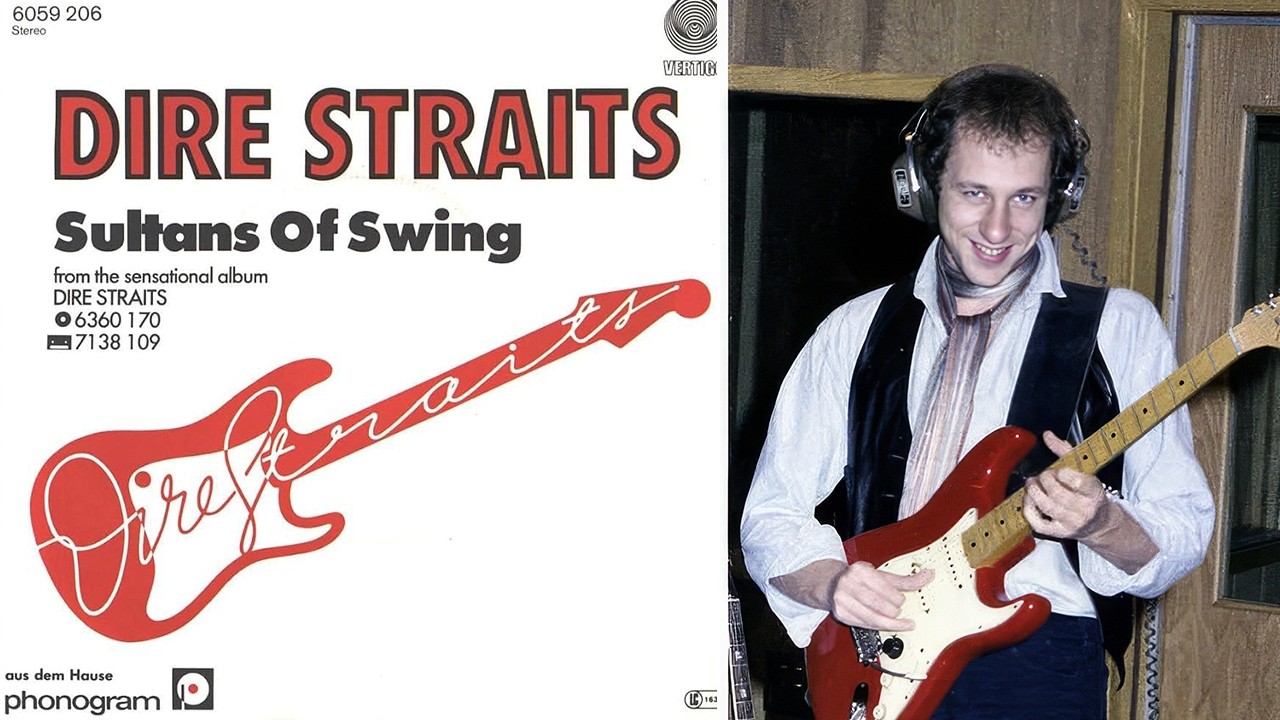
Inspired by this comedic encounter, Knopfler wrote the initial version of the song using a national steel guitar and was around for a while before it was really brought to life by the purchase of a new instrument. This was a red 1961 fender Stratocaster that would be used all over the first album and throughout his career.
A first version of Sultans was recorded at Pathway Studios mid 1977 with my friend John Tilly engineering. This found its way onto the radio which helped them land a record deal with Vertigo records. John said that the Pathway version was totally live and spontaneous with Knoplfer leaning with his left leg on the amp and firing away.
With proper record deal in place it was time to record an album as they entered The band entered Basing Street Studios in February 1978.
Basing Street was an important London recording facility, originally associated with Island Records and later known as SARM West. The album was produced by Muff Winwood and engineered by Rhett Davies.
The studio featured upgraded 32-input / 24-output Helios desks outfitted with the highly coveted Type '69 mic preamps and EQ modules. These consoles were legendary for a punchy, aggressive midrange and a distinct low-end warmth that suited guitar-driven rock.
Though the band had recorded their original 5-song demo tape on an 8-track machine at Pathway Studios, their major-label sessions at Basing Street utilized a 3M M79 24-track 2-inch tape machine .
Knopflers 61 Strat was originally stripped down to a bare wood finish by its previous owner before being repainted a vibrant red—inspired by Hank Marvin of The Shadows. To achieve the track’s iconic crisp, tone, Knopfler famously jammed the guitar's three-way pickup selector switch right into the middle position to engage both the neck and middle pickups simultaneously.
His amplifier for the session was actually borrowed from John Isley, this was a 1961 brownface Fender Vibrolux. The combination of the new Strat and vibrolux was really the secret to the revival of the sing. Knopfler has said that teh way he wrote originally wrote it on the national steel guitar in open tuning was uninspiring but as soon as he started to play it with the new set up then it really came alive.
Before he even joined date band Pick withers was already an established drummer on the 70s music scene having played with artists such as Gerry Rafferty and Dave Edmunds eventually becoming the house dummer at Rockfield studios.
To do this he utilized a custom-built kit by legendary London master drum builder Eddie Ryan. Eddie Ryan kits were highly sought after by prominent UK session players in the 1970s for their premium wood plies and focused, musical resonance.
His snare was the 1972 Gretsch USA Custom 14”×5” snare drum (Model 4158).
The sound they achieved at basing street was typical of the mid to late 70’s in that was pretty dry and free of any over inflated harmonics created by heavy room compression techniques. This was achieved using close mics such as an AKG D12 on the kick drum, A Shure SM57 on the snare, with U87’s to pick up the kit sound. The toms definitely sound some form of dampening was applied also.
His controlled drumming also helped in creating a tight sound as well with all good drummers capable of playing with this ability to almost self mix themselves.
John Illsley played his 1959 Fender Precision Bass through the studios own Ampeg SVT, the cab was mic’d with an AKG D20 with a DI also taken.
David knopfler also played a 61 Fender Stratocaster this had a modification in the form of a a DiMarzio FS-1 pickup modification in the middle position. He also had a harmony Sovereign acoustic guitar. David primarily used a Peavey Deuce VT hybrid amplifier (featuring a solid-state preamp/power section paired with power tubes and dual 12-inch speakers) during the band's early touring and recording era.
Neuman U87’s were used to mic up the guitar amps.
After the album had been recorded , the record company still had concerns about the sound they had for sultans and were concerned it wasn’t the right sound for radio and that was it too polished. This led them to return to Pathway Studios in April to re record it, This version was more compressed and had more obvious rock characteristics and did actually end up being released in some territories but the basing street recording became the main version both as a single and the album version.
Although there are some differences, one aspect that never changes is Knopflers distinctive vocal style. Hi almost conversational Story telling way of singing is huge part of the songs charm, he verbally paints the pictures of the scene using theatrical inflections rather than any fancy trills. Im sure a decision born out of necessity rather than choice but it is a unique style that that is very much his own,
A a lead up to the album, Sultans was released in May 1978 but unfortuanltey failed to chart. It started to gain some interest in Europe and with a US release in January 79 it finally started to show up in the charts reaching number 4 on the billboard hot 100. One of the reasons for its lack of success in the UKwas the BBC’s refusal to play it based on the fact it was too lyric heavy. With its international success they had to concede and began playing it. With some decent exposure it reached number 8 and helped promote the album also.
Gaining traction in teh US more than anywhere else they played Sold out tours and also had an invitation from Bob Dylan to Knofler and withers to play on his new album. The group did have few member changes over the years but as a concept through knopflers magical fingers and impeccable e story telling, the band went form strength to strength hitting their peak in 1985 with release often mighty brothers in arms.


Comments